
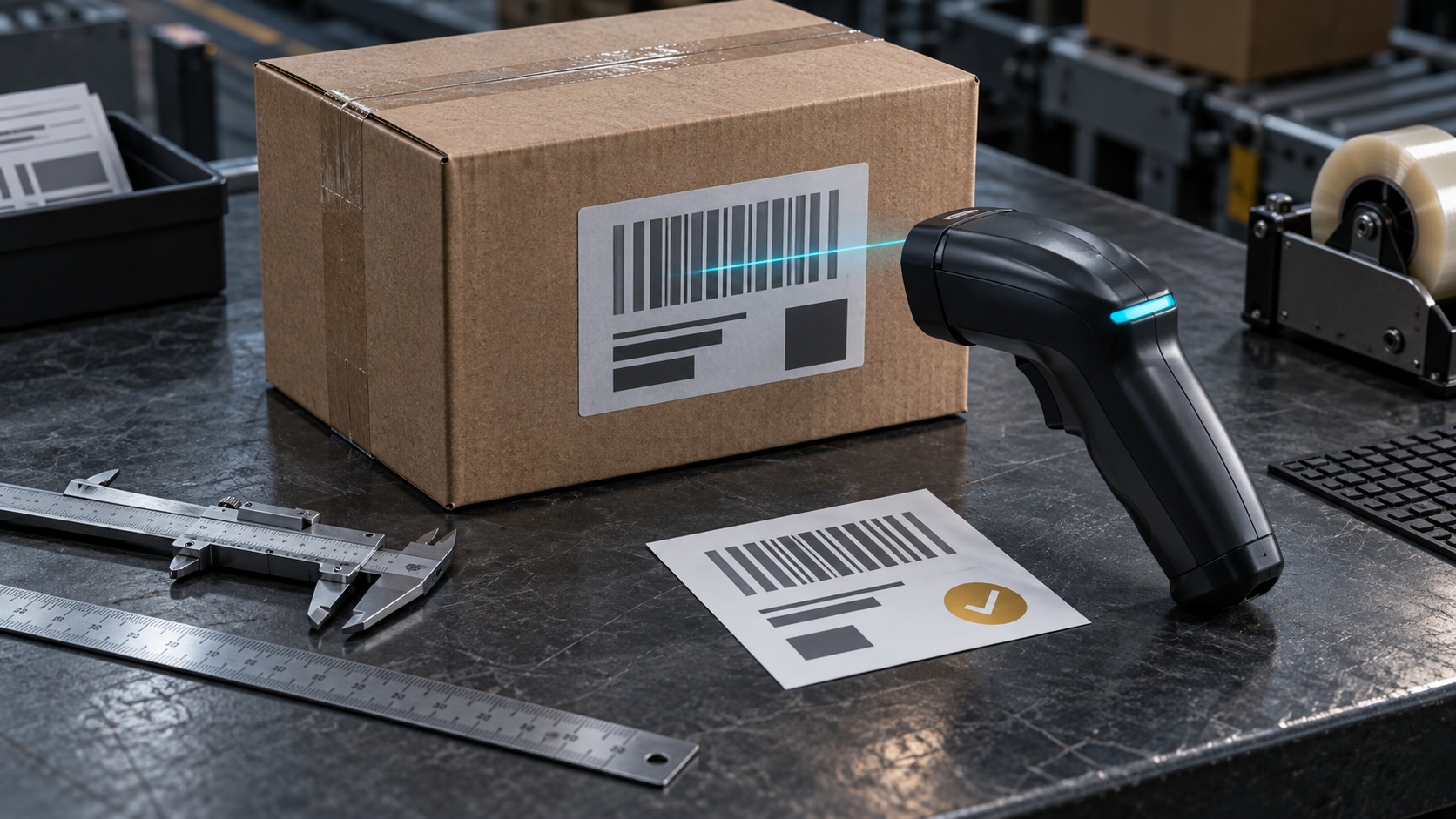
A barcode is not finished when an artwork file looks clean. Before dispatch, a buyer needs to know whose data it is, which packaging level it identifies, whether the receiving operation can scan it and which version is actually on the shipment.
This is a practical control method, not GS1 licensing, retailer, customs, carrier, contract or legal advice. The brand owner, buyer and authorized operational owners must confirm transaction-specific label requirements in writing.
1. Map the packaging levels before choosing a code
List the retail unit, inner pack, carton and any logistic unit that needs separate handling. For each level, record the pack quantity, receiver, scanning use and label location. A carton containing retail units does not automatically inherit every retail identifier.
2. Confirm the data owner and the live allocation
Ask the brand, buyer or authorized data owner for the current GTIN allocation, packaging configuration, target market and label rule. Record its source, date and applicable SKU in the label review. A manufacturer can apply approved data; it should not invent, alter or guess customer product identifiers.
3. Separate product identity from logistic-unit identity
Retail product identification and logistic-unit tracking solve different problems. Where a GS1 logistic label is required, the logistic unit is commonly identified through an SSCC; the GS1 General Specifications describe GS1-128 as the mandatory data carrier for individual logistic units. Agree who assigns the number and when before labels reach the warehouse.
4. Freeze a reviewable label proof
A useful proof shows the packaging level, source version, human-readable fields, barcode type, label location and applicable buyer or market. The GS1 Logistic Label Guideline says barcoded information should also be shown in human-readable form, while the exact fields, number of labels and placement remain subject to the receiving operation's written requirements.
5. Accept the physical print, not the PDF
Scan a label applied to the actual carton, including the intended print, laminate and sealing conditions, using the buyer's specified or equivalent device. Record the result, data read, placement, print batch and exception. GS1 treats regular verification as part of quality control, both at initial implementation and on an ongoing basis.
6. Hand the approved result to dispatch owners
Share the approved packaging hierarchy, label revision and necessary logistic-unit information with warehouse, documentation and freight owners. The packing list, shipping instruction and label do not need to repeat every field to look identical. They do need to identify the same goods, quantities, pack level and approved version when traced together.
Pre-dispatch evidence card
Keep these six records
- Packaging hierarchy and pack quantities
- Authorized data source, revision and SKU scope
- Whether an SSCC is required and who assigns it
- Approved label proof, readable fields and placement rule
- Actual printed-label scan result and exception record
- Effective revision shared with warehouse, documents and freight owners
Sources and limits
Published 20 September 2026, this guide uses the GS1 General Specifications and the GS1 Logistic Label Guideline as its general reference. A retailer, brand owner, warehouse, carrier or destination market may impose more specific current rules; use their written instructions for the shipment.
Frequently asked questions
Can an outer carton reuse the retail-unit GTIN?
Confirm the packaging hierarchy and the buyer's written rules first. A retail unit, inner pack, carton and logistic unit may need different identifiers; do not assume a code can be reused.
Can a QR code replace GS1-128 on a logistic label?
That depends on the trading partner, label standard and scan environment. Any substitution should be approved by the receiving party and tested on actual printed labels.
Why can a label look correct in a PDF but fail at receiving?
Print contrast, size, placement, laminate, folds, damage and the scanner itself affect readability. Review an actual printed label with the relevant scanner, not only the artwork.