
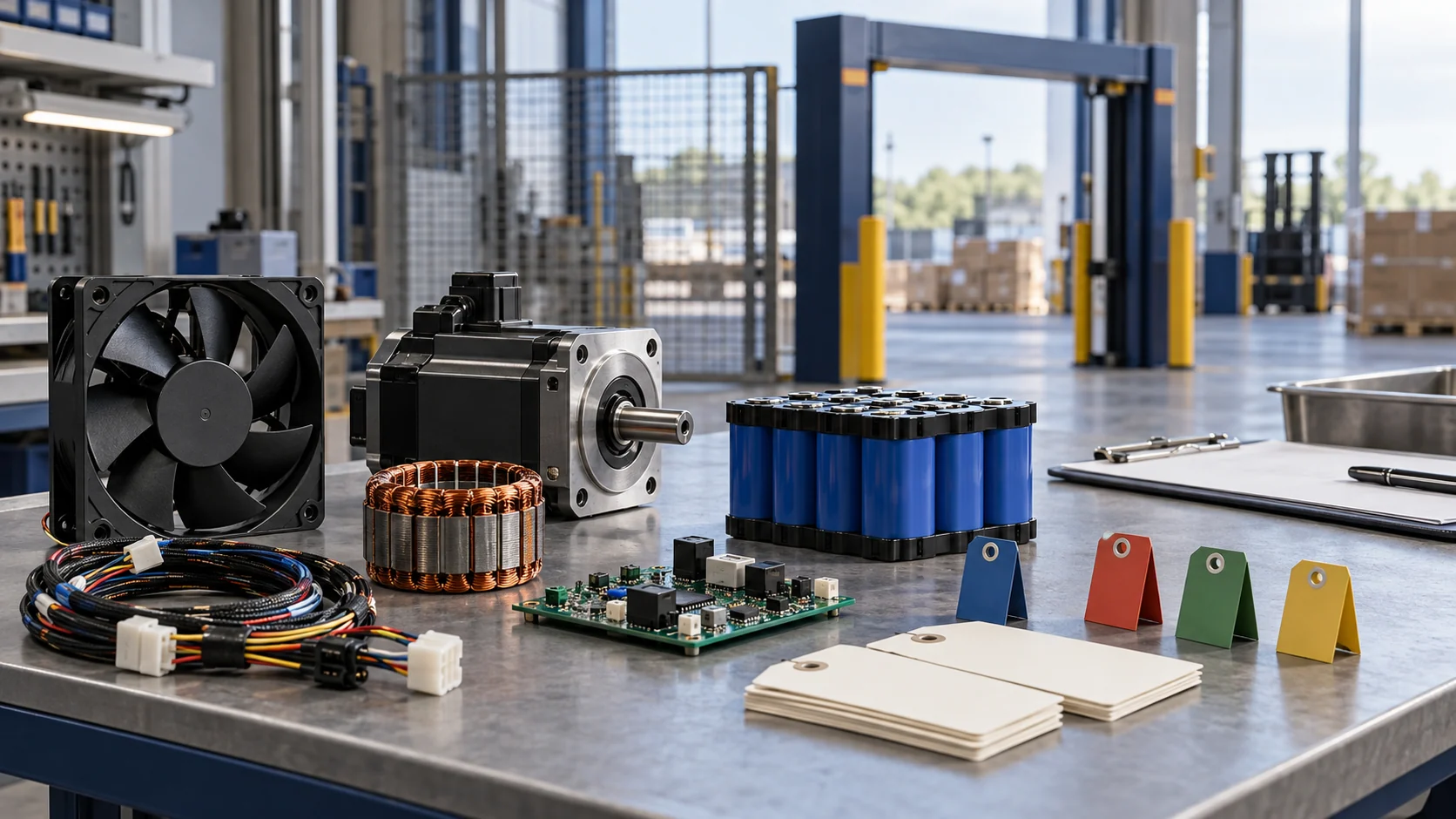
The U.S. Foreign-Trade Zones Board published a proposed production-activity notification on 9 October 2026 for Sanyo Denki America’s Torrance, California facility in FTZ 50. The products and inputs include fans, motors, drives, wiring, batteries, sensors, controllers and integrated circuits. For a supplier already involved in a relevant U.S. production project, the useful step is to complete a part-level origin BOM—not to treat the notice as an RFQ or an automatic duty benefit.
Start with three checks
Confirm a real project relationship, obtain the actual producer and country-of-origin basis for each part, and ask the U.S. importer, FTZ operator or customs professional to confirm classification, trade measures and admission status. Otherwise, keep the notice as a market signal only.
1. Separate notification, authorization and admission
Document 2026-20776 is a proposed production-activity notification. The FTZ Board received it on 24 September, and comments are due by 18 November 2026. It does not grant final authority or identify suppliers, source countries, RFQs or purchase orders.
2. Read the listed products as procedural scope
| Published fact | What it cannot establish |
|---|---|
| Proposed finished products include fans, motors, converters, batteries and distribution equipment, with general duty rates from free to 5.7% | That a finished product is authorized |
| Foreign-status inputs include wiring, drives, sensors, controllers and integrated circuits, with general duty rates from free to 8.5% | That an input is being sourced publicly |
| Some inputs may face Section 232 or 301 measures depending on origin | That every similar component has the same treatment |
3. Keep seven groups of fields
| Field | Owner | Evidence |
|---|---|---|
| Part number, revision, material and function | Supplier engineering or sales | Drawing, specification and BOM revision |
| Actual producer and location | Supplier | Manufacturing statement and facility facts |
| Country of origin and basis | Supplier facts; importer review | Inputs, processing and dated origin record |
| Proposed HTS and rationale | Importer classification owner | Classification note and confirmer |
| Trade measures | Importer or customs professional | Controlling action and effective date |
| FTZ admission status | FTZ operator or customs professional | PF, other status or unknown |
| Gap, owner and completion condition | Project owner | Open issue and trigger |
Keep unknown fields visible. An export country is not automatically origin, and a similar part’s HTS is not evidence for the actual component.
4. Keep origin and classification separate
Origin depends on manufacturing and transformation facts. HTS depends on the objective merchandise and tariff rules. A change may trigger a Section 232, Section 301, AD/CVD or other review, but one field does not prove the other.
5. Understand privileged foreign status
Under 19 CFR 146.41, eligible foreign merchandise may receive privileged foreign status after proper application. The status remains binding in the zone even if merchandise changes form. It is not duty-free treatment and does not automatically remove Section 232, Section 301, AD/CVD, licensing or other requirements.
6. Handoff by role
The supplier provides part, producer, location and origin facts; the U.S. importer confirms classification and import measures; the FTZ operator or customs professional records admission status; the project owner controls gaps and versions. No one record replaces the FTZ Board or CBP decision.
7. Set review triggers
Review affected BOM rows when the comment period closes, when the FTZ Board issues a decision, or when product, producer, origin, HTS or trade measures change. Preserve the previous version and reason.
Facts, analysis and unknowns
Source facts: the notification lists products and inputs, duty-rate ranges, possible Section 232 and 301 conditions and the comment deadline. CZ Overseas analysis: a related supply chain should build a part-level origin BOM. Unknown: suppliers, source countries, orders, item classifications, final authorization and shipment treatment were not published.
Primary sources: Federal Register 2026-20776, the govinfo PDF, 15 CFR 400.22, 19 CFR 146.41 and the Commerce FTZ overview. Checked 11 October 2026.
Frequently asked questions
Does the notice prove that a company is buying the listed components?
No. It does not identify approved suppliers, RFQs, purchase orders or final authorization.
Does privileged foreign status mean duty-free entry?
No. Duty and other measures still depend on merchandise, origin, law and entry handling.
Does a complete BOM prove compliance?
No. It supports review; it does not replace decisions by the importer, FTZ operator, customs broker, CBP or FTZ Board.
What this lets readers complete
China component suppliers can provide a reviewable part-level origin BOM. U.S. import and FTZ teams can identify gaps without treating a public notification as an RFQ or automatic duty benefit.
Continue the review
Use the Section 301 cost guide and the AD/CVD scope guide. For help organising public information, contact Chris without sending confidential records.