
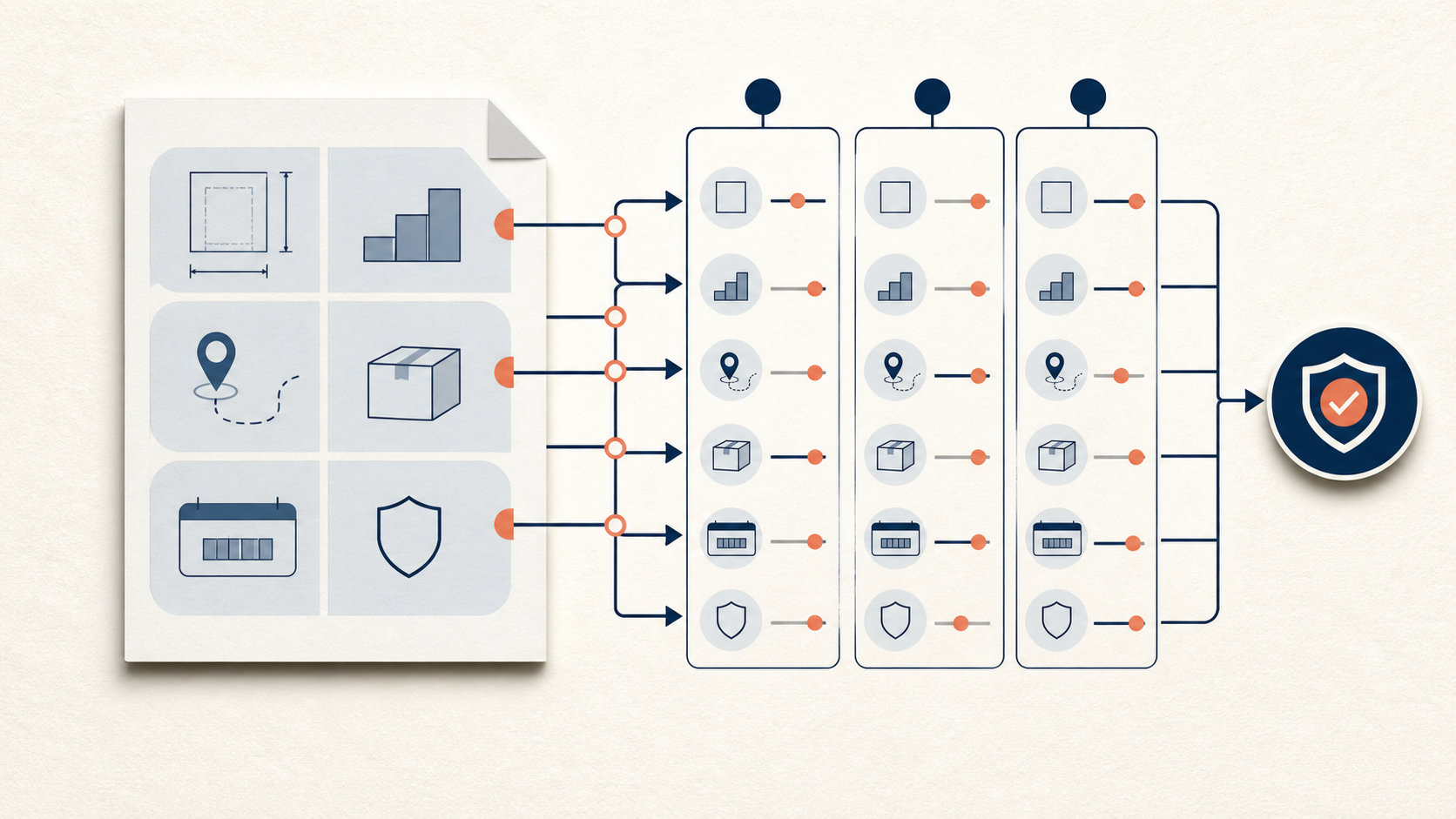
The lowest unit price is often not the lowest comparable offer. One supplier may quote a different drawing revision, another may exclude export packing, and a third may use the same three-letter Incoterm without naming the actual hand-off point.
Before ranking suppliers, normalize the scope. A useful comparison should answer three questions: Are the suppliers pricing the same product? Does each price cover the same responsibility boundary? Which assumptions could change the price or lead time after the purchase order?
1. Lock the same product and revision
Start with the product name, part or model number, drawing or specification revision, material or process requirements, unit of measure, and buyer-required tests or documents. If the specification is not final, identify every open point instead of allowing suppliers to make different silent assumptions.
“According to sample” is not a sufficient reference when the buyer and supplier may be holding different samples. A revision-controlled drawing or specification sheet gives every quotation the same technical baseline.
2. Normalize quantity, MOQ and price breaks
Compare the requested quantity, minimum order quantity, price tiers and unit of measure in one table. Separate recurring unit prices from non-recurring engineering, tooling, sampling or setup charges.
This prevents a low unit price at an unrealistic volume from appearing cheaper than a quotation built around the actual order quantity.
3. Put currency, tax basis and validity beside the price
Record the quoted currency, whether any China-side taxes are included, the validity period and what happens after expiry. Do not assume a long validity period is automatically safer; ask which material, freight, volume and exchange-rate assumptions support it.
4. Compare the Incoterm, named place and version
Three letters are incomplete without a location. ICC recommends the structure [chosen rule] [named port, place or point] Incoterms® 2020.
Incoterms allocate specific delivery, risk, cost and task obligations. They do not determine title transfer, payment timing, quality acceptance, remedies for breach, tariffs, or whether a party is legally able to act as importer in a destination country. Those issues belong in the sales contract and destination-specific review.
For any DDP offer, ask which legal entity will be the importer, who will appoint the broker, which duties and taxes are included, and which events can change the delivered price. For a fuller explanation, read the FOB, EXW and DDP decision guide.
5. Normalize packing and logistics assumptions
Ask for the packing method, package count, estimated net and gross weight, carton or pallet dimensions, stackability, and any special treatment such as wooden cases, anti-corrosion materials, fumigation, labeling or dangerous-goods handling.
These details affect freight and handling. They also need to remain consistent with later commercial invoices and packing lists. Treat quotation-stage figures as estimates until the final packing data is confirmed.
6. Separate samples, tooling, testing and documents
List sample charges, courier costs, tooling or fixtures, testing, third-party inspection, certificate work and special documentation as separate rows. For each row, identify who pays, what is delivered, when it is due, and whether any amount is refundable or credited against a production order.
Do not treat “testing available” as evidence that a product is already certified for your market. Verify the exact product, model, standard, report holder, issuing body and destination-market requirement separately. The China supplier evaluation guide remains the main page for broader supplier verification.
7. Compare lead time from the same starting event
“30-day lead time” is not comparable until the starting event is defined. It may begin after deposit, purchase order, final drawing approval, sample approval, receipt of buyer-supplied material, or another condition.
Separate sample or tooling time, production time, inspection or rework allowance, and the point at which the supplier performs delivery under the chosen Incoterm. Carrier transit time should remain an estimate unless the seller has accepted a specific contractual obligation.
8. Compare payment, exclusions and change triggers
Record the payment method, milestones, required documents and beneficiary identity independently from the Incoterm. Title transfer, acceptance, warranty and breach remedies also require separate contract language.
Then list exclusions and triggers for a revised quotation: drawing or material changes, volume changes, packaging upgrades, expanded testing, a new delivery point, or expiry of the quotation. A clear change process protects both parties from executing different versions of the deal.
A normalized quotation comparison table
| Comparison field | Supplier A | Supplier B | Supplier C |
|---|---|---|---|
| Product / drawing revision | |||
| Requested quantity / MOQ | |||
| Unit price / price breaks / currency | |||
| Tooling, samples and one-off costs | |||
| Incoterm + named place + 2020 version | |||
| Packing / weight / dimensions | |||
| Testing and documents included | |||
| Lead-time starting event | |||
| Payment milestones | |||
| Validity / exclusions / change triggers |
Use “not provided” rather than guessing. Every empty cell becomes a clarification question before the order is awarded.
Seven quotation red flags worth clarifying
- The product or drawing revision is missing.
- The price is tied to an unstated or unrealistic quantity.
- The Incoterm has no named place or version.
- Packing, tooling, testing or documents are hidden behind “included as needed.”
- Lead time has no starting event.
- DDP is offered without identifying the importing arrangement or tax assumptions.
- The supplier cannot explain what changes would require a new quotation.
These are not automatic proof of fraud or poor capability. They are reasons to pause the comparison and request a complete answer.
A short clarification email
Please revise the quotation against the attached specification revision and requested quantity. Show the MOQ and price breaks, separate tooling and sample costs, state the Incoterm with the exact named place and Incoterms® 2020, identify the lead-time starting event, and list packing, testing, documents, exclusions and quotation validity. Please mark any unavailable field as “not provided” rather than making an assumption.
Conclusion: compare the operating boundary, not only the number
A normalized quotation makes differences visible before they become disputes. It helps the buyer understand whether a price advantage comes from scale, scope, risk allocation, payment timing or a missing cost.
Supplier evaluation still requires legal, technical, quality and commercial verification. This checklist has one narrower job: make the quotations comparable before you decide which suppliers deserve deeper review.
Primary sources and limitations
- ICC: Incoterms® 2020 questions and answers — scope, named-place format and separation from title and payment.
- WTO: Customs Valuation Technical Information — transaction value and the valuation-method hierarchy.
- U.S. International Trade Administration: Commercial Invoice — invoice use and destination-specific document requirements.
- U.S. International Trade Administration: Common Export Documents — packing-list fields and consistency with the commercial invoice.
- U.S. Customs and Border Protection: Commercial invoice value — valuation adjustments showing why a naked unit price is not a universal final customs value.
Sources were checked on 28 August 2026. This page provides a general, anonymized comparison method and is not legal, tax, customs, certification or financial advice.
Frequently asked questions
What should I compare besides unit price?
Compare the product revision, requested quantity and MOQ, one-off costs, currency, Incoterm and named place, packing assumptions, testing and documents, lead-time starting event, payment milestones, validity, exclusions and change triggers.
Do Incoterms decide ownership or payment?
No. ICC states that Incoterms do not deal with title transfer and do not set the time, place, method or currency of payment. Put those terms in the sales contract and related documents.
Is a missing field proof that a supplier is unreliable?
Not by itself. Mark it as not provided and request clarification. The answer and supporting evidence should then form part of the wider supplier-evaluation process.
Can a supplier guarantee my final landed cost?
Only within a clearly defined contractual and customs scope. Duties and taxes depend on the destination, classification, origin, valuation adjustments and importing structure, so the buyer should verify destination-specific treatment.