
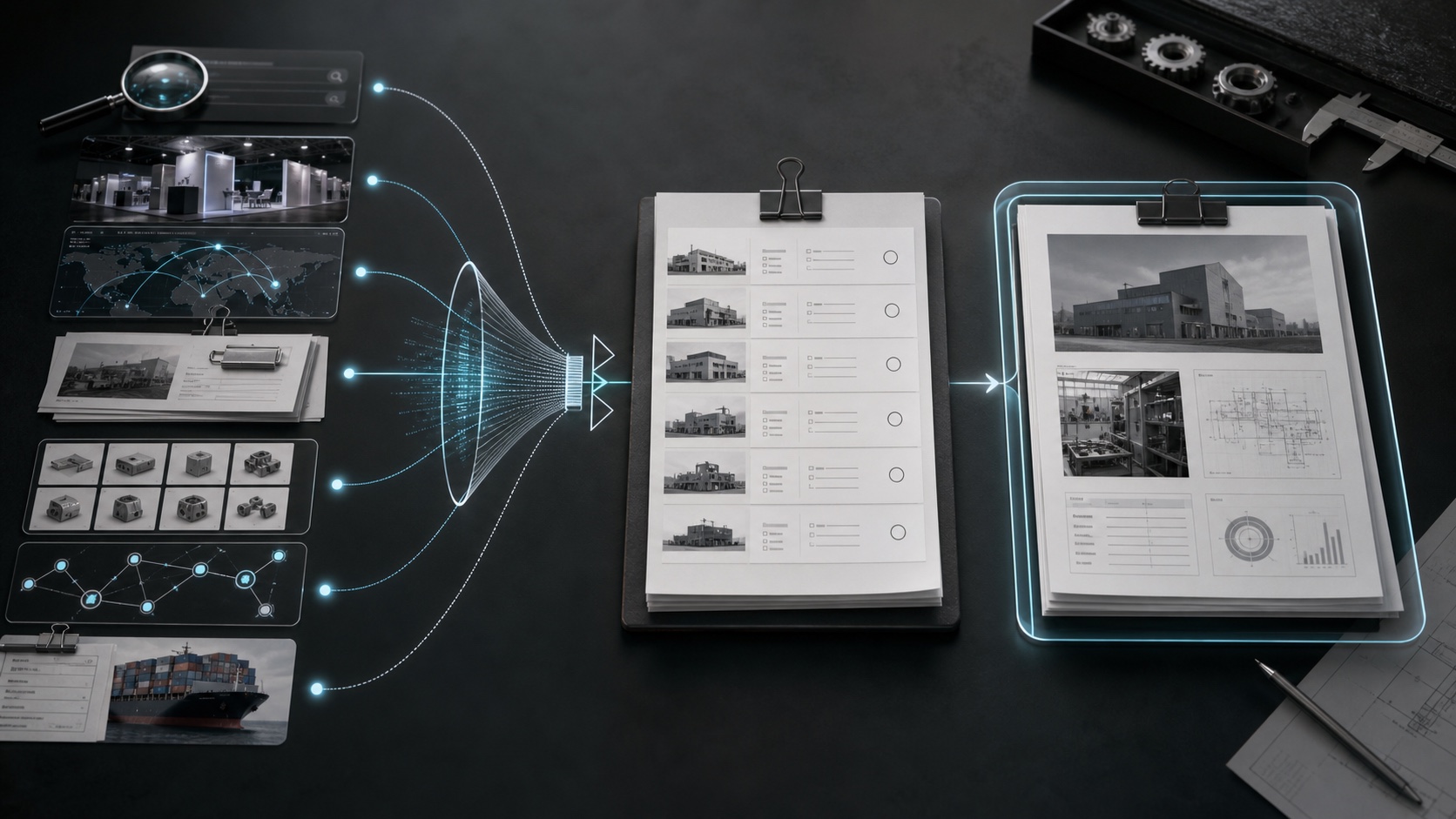
Finding a long list of companies in China is easy. Building a shortlist that fits your product, order size, quality requirements and destination market is much harder.
The practical approach is to use more than one discovery channel, capture the same information for every candidate, and keep discovery separate from verification. A supplier appearing in a directory, trade-fair list, shipment record or LinkedIn search has given you a lead—not proof that it can deliver your order.
This guide explains seven places to find Chinese manufacturers and a simple method for turning names into a shortlist. The next stage—legal identity, capability, samples, compliance and commercial risk—is covered in our dedicated guide to vetting a Chinese supplier.
Before searching, write a sourcing brief
A vague request produces a noisy supplier list. Before opening a platform or directory, write down:
- the product and intended use;
- material, dimensions, finish and tolerances;
- expected order quantity and reorder pattern;
- customization, packaging and labeling needs;
- target market and known compliance requirements;
- target delivery window;
- which processes must be controlled by the supplier;
- what evidence you will request at the shortlist stage.
This brief gives every search channel the same reference point. It also prevents you from comparing quotations built on different assumptions.
1. Search engines and process-specific keywords
Google and other search engines work best when the query describes the manufacturing problem, not only the finished product. Combine the product with a material, process, application or region—for example, “custom injection-molded enclosure manufacturer China” instead of “plastic supplier.”
Search results can reveal factory websites, product pages, industry directories and technical content. Look for specific evidence: processes, material limits, product examples, engineering documents and a clear legal or operating identity. Generic claims such as “high quality” and “best price” do not help you decide whether a company belongs on the shortlist.
2. B2B marketplaces and supplier directories
B2B platforms are efficient for collecting company names, product images, approximate MOQs and contact routes. They are useful for building a broad first pool, especially for standardized products and private-label categories.
Treat platform badges and supplier labels as one input. Check exactly what a label covers and when it was issued. It should not replace your own legal-entity check, product-fit questions, sample process or production-capability review.
Use the same RFQ for every candidate. If suppliers quote different materials, packaging or testing assumptions, the prices are not comparable.
3. Trade fairs and official exhibitor directories
Trade fairs allow a buyer to meet many suppliers, inspect sample quality and discuss a project quickly. Official exhibitor directories can also be used before and after the event to identify companies by product category.
Prepare a short question set before a meeting:
- Which production steps are performed in-house?
- What is normally outsourced?
- What order sizes fit the factory best?
- Which markets and product standards does the team understand?
- Who will own the next action after the fair?
Exhibiting at a fair is a discovery signal. It is not evidence that the exhibitor has already passed your legal, technical or quality review.
4. Public trade data and shipment records
Market-level trade statistics can help you understand which countries and product categories deserve research. Where coverage fits, shipment-level records may reveal names connected to U.S. ocean imports.
These records have important limitations. A shipment name may be an exporter, trading company, logistics party or related entity rather than the factory. Coverage differs by country and transport mode, and a historical shipment does not prove current capacity or quality.
Use trade data to form questions. Our guide to public trade data for sourcing markets and supplier claims explains what each data layer can—and cannot—prove.
5. Industry associations, manufacturing clusters and specialist directories
Experienced buyers often search by process and industrial cluster before searching by company. Industry associations, regional directories, technical media and specialist events can narrow a large market to a more relevant group.
A cluster is not a guarantee. The advantage is search efficiency: you are more likely to find companies familiar with the material, tooling, subcontractors and supporting services behind a particular product. You still need to confirm which processes each candidate actually controls.
6. Referrals from customers, engineers and industry peers
A referral can provide useful context that a directory cannot: what the supplier made, how communication worked and where problems appeared. Ask the referrer to describe the product and period involved rather than simply saying the supplier is “good.”
Past performance on one product does not guarantee fit for another. Use the referral to start a focused conversation, then apply the same shortlist and verification process used for every other candidate.
7. Sourcing companies and on-the-ground partners
A sourcing partner may be useful when the buyer does not speak Chinese, needs several processes coordinated, lacks time to visit factories or is developing a custom product.
Before engaging one, clarify:
- how the service is paid;
- whether it receives supplier commissions;
- which supplier-search and verification steps are included;
- who owns quotations, samples and supplier records;
- how conflicts of interest are disclosed;
- what happens if the first shortlist is unsuitable.
A directory listing or institutional introduction should not be treated as an endorsement. The U.S. Commercial Service, for example, explicitly recommends conducting your own background research on listed service providers.
Turn a long list into a useful shortlist
| Field | What to record | Why it matters |
|---|---|---|
| Legal identity | Chinese legal name, English name, registration number | Prevents confusion between brands, exporters and factories |
| Discovery source | Search, marketplace, fair, data, referral or sourcing partner | Shows the strength and limits of the lead |
| Product fit | Relevant products, process, material and application | Removes companies that only look similar at category level |
| Order fit | MOQ, customization, lead time and capacity range | Tests whether the supplier fits your commercial scale |
| Market fit | Experience and evidence relevant to the destination market | Identifies compliance questions early |
| Response quality | Completeness, specificity and ownership of next actions | Shows whether technical and commercial communication can work |
| Evidence gap | What still needs to be verified | Creates the next-stage due-diligence plan |
Do not rank suppliers by quoted unit price until the scope is comparable. A low quotation may exclude tooling, packaging, testing, material grade or realistic production lead time.
What discovery cannot prove
Discovery channels do not, by themselves, prove:
- that the company is the legal contracting party;
- that it owns or controls the factory shown online;
- that current capacity matches your order;
- that certificates cover your exact product and current period;
- that shipment records represent manufacturing rather than trading;
- that samples will match mass production;
- that the supplier can comply with your target-market rules;
- that payment, IP and contract risks are acceptable.
Once the list is short enough to justify deeper work, move to the China supplier evaluation process. For higher-risk projects, a factory audit, sample approval and pre-shipment inspection may form separate controls.
Frequently asked questions
What is the best website to find manufacturers in China?
There is no single best website for every product. B2B platforms may work well for standardized goods, while custom or technical products often require a combination of search engines, trade fairs, specialist directories, referrals and local support.
Is Alibaba enough to find a reliable manufacturer?
It can be a useful discovery channel, but a platform profile does not complete legal, technical, quality or commercial verification. Use the same product brief and evidence request across several candidates.
Can I use 1688 to find Chinese factories?
It may provide additional domestic-market leads, but language, account access, payment, exporter identity and product documentation can make the process harder for overseas buyers. A listing still needs to be matched to the legal and manufacturing entities behind the offer.
Can LinkedIn help me find Chinese suppliers?
LinkedIn can help identify a company and the people responsible for sales, sourcing or operations. It is a contact and professional-information layer, not a factory-verification system.
Should I choose a factory instead of a trading company?
Choose the operating model that fits the order. A factory may offer stronger process control; a transparent trading company may coordinate several factories, lower quantities or complex product sets. The important questions are who controls each process, who signs the contract and who is accountable for quality and delivery.
Sources and interpretation limits
- National Enterprise Credit Information Publicity System, search help — public market-entity information can be searched by company name, Unified Social Credit Code or registration number.
- U.S. Commercial Service, services in China — partner-search and initial background-research services available to eligible U.S. companies.
- U.S. Commercial Service, China business service providers — directory inclusion is not an endorsement and users should conduct their own background research.
- Canton Fair official website — official event and exhibitor discovery entry.
Sources were rechecked on 18 August 2026. A government record, directory listing, trade-fair profile or historical shipment is one input. None proves that a supplier can meet the current product, order, quality, compliance or delivery requirement.