
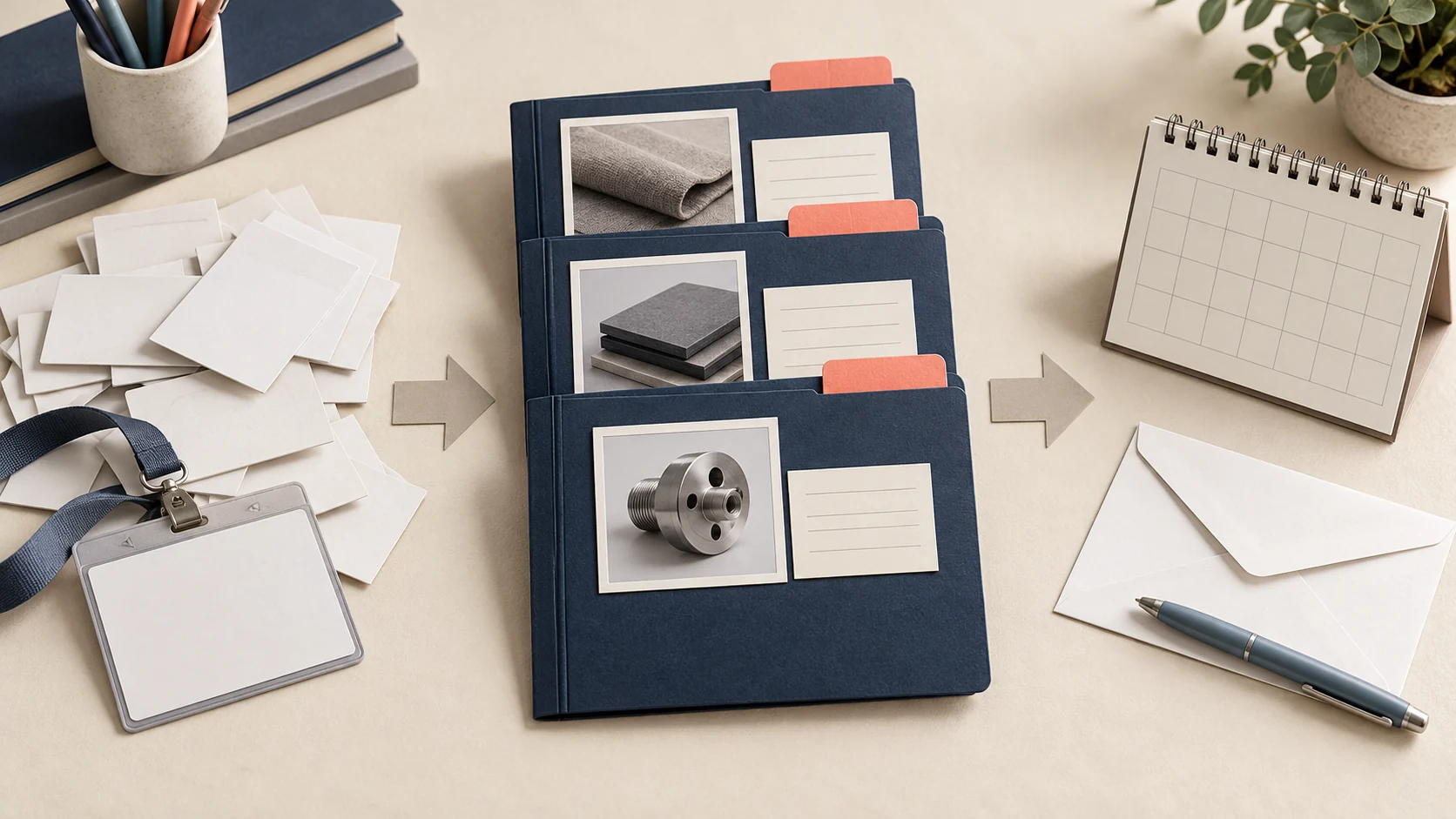
A stack of business cards from the Canton Fair is a starting point. Before requesting samples from every exhibitor, turn each useful conversation into a record of the product, the supplier’s actual role, missing evidence and one agreed next step. This guide is for overseas buyers building a manageable China supplier shortlist, including while the fair is still running.
What this guide covers
The official 140th Canton Fair schedule is 15–19 October, 23–27 October and 31 October–4 November 2026. As of publication on 14 October, the first phase has not started. Prepare the record before your visit and use it each day; confirm any schedule change through the organiser.
The U.S. International Trade Administration recommends recording conversations and next steps, with a 48–72-hour follow-up aim for promising leads. That guidance addresses U.S. exporters. The buyer-side shortlist, responsibility checks and review cadence below are CZ Overseas recommendations, not a supplier certification or a proven conversion formula.
1. Connect the contact with the product you discussed
Record the company’s trading name, contact role, booth, conversation date and specific model or sample reference. Keep your permitted photographs and notes together. Ask whether the exhibitor manufactures the item, trades it or represents another producer; keep an unverified answer labelled as a claim. A booth presence does not establish factory ownership.
Separate contacts from companies and projects. Two people from one company may handle different product lines. Merge confirmed duplicates without erasing the original conversation. Mark missing quantities, destination-market requirements and buying dates as unknown.
2. Send a small, consistent requirement brief
State the application, essential specification, target market, indicative order range if known and the decision you need to make next. Ask each shortlisted supplier to respond against the same version. Link to drawings or specifications using an approved channel rather than scattering different revisions across messages.
Do not invent an order quantity to obtain a lower price. If volume is not approved, request the relevant price breaks and identify the quote as indicative. For a full requirement baseline, use the product specification guide.
3. Separate a promising conversation from a verified supplier
| Current evidence | Next action | Decision still unavailable |
|---|---|---|
| Relevant product and a named technical contact | Request the missing specification or capability evidence | Supplier approval |
| Similar product but unclear manufacturing role | Confirm the producing entity and who controls changes | Factory ownership or production capacity |
| Useful sample but no agreed acceptance criteria | Define what the sample must demonstrate | Production or market-compliance approval |
| Generic catalogue with no project fit | Ask one fit question or park the contact | A purchase recommendation |
Prioritise by the decision you can advance, not by booth size or response speed alone. Supplier identity and capability checks belong in a separate supplier evaluation.
4. Make the first follow-up easy to answer
Reference the actual conversation, attach or link the agreed brief, and ask for one concrete deliverable. The example below is a fictional template. Replace brackets with confirmed details:
Subject: [Product] follow-up after [fair / booth]
Hello [name], we discussed [application / model] at [event]. Attached is revision [reference] of our requirement brief. Please confirm [one key point] and identify any deviations before preparing [a quotation / sample proposal]. Could [named contact] reply by [agreed date and time zone]? Please tell us if a different colleague should handle the technical review.
Use the channel agreed at the booth. A contact exchange does not automatically authorise newsletter subscriptions or repeated mass messages. Keep confidential specifications in your company’s approved system.
5. Keep a record another buyer can use
The visiting buyer or sourcing owner fills this record from booth notes, the current brief and supplier replies. The output is an accountable next step, not a pass/fail compliance result. Copy these manual fields into your own spreadsheet; this page does not collect a submitted record.
- Contact and project
- Company / contact / role / booth / date / project reference
- Product and requirement
- Model or sample / application / destination market / brief revision
- Evidence status
- Confirmed facts / supplier claims / unknowns / not applicable with reason
- Commitments
- Requested material / promised response / version received and date
- Next decision
- Owner / due date and time zone / missing item / review trigger
- Current stage
- Clarification / capability review / sample review / comparable quote / parked
A complete record does not prove that the supplier is genuine, the product complies, the quotation is valid or an order exists. Keep approvals and contractual commitments in their separate processes.
6. Review open gaps before ordering samples
At the end of each fair day, reconcile your notes and promises. CZ Overseas suggests a first-week review of active candidates, adjusted to each agreed buying timetable. Ask whether the supplier answered the actual question, which deviations remain and what evidence would justify the next spend. An unanswered point remains unknown even if the rest of the file looks complete.
If a reply changes the model, producing entity or specification, retain the old record and note what changed. Where no reply arrives, check the address and the clarity of the request before a focused reminder. Park a contact when there is no project fit or meaningful next action; resume when new information appears.
7. Compare the decision stage, then the price
Use a shortlist with the same requirement revision, evidence categories and open questions for every candidate. Keep a quoted offer, a sample under review and a supplier awaiting clarification in distinct stages. A low price against an incomplete specification cannot answer which supplier is the best fit.
Track delivery of agreed evidence, closure of requirement gaps and movement to a justified sample or quote review. Replies, sample shipments and catalogue downloads are not orders. Once offers are comparable, use the quotation comparison guide and the sample approval guide.
Evidence boundaries and review triggers
The official sources support the event dates and broad advice to record, personalise and review follow-up. The seven-step buyer process is our operational judgement. Actual supplier identity, authority, capability, compliance and purchasing outcomes remain project-specific and unverified until checked. Sources were reviewed on 14 October 2026; revisit the event context if the organiser changes its schedule, and revise a supplier record when new evidence changes the decision.
Overseas buyers can now leave the fair with a shortlist that a colleague can act on, request comparable evidence and avoid treating a friendly booth conversation as supplier approval.
- ITA: A Rural Business Guide to Trade Show Success — method reference, not a new announcement.
- ITA: Tips for Trade Show Success: Part III — published 22 March 2016.
- MOFCOM: introduction and phase schedule for the 140th Canton Fair.
Frequently asked questions
Does a Canton Fair booth confirm that a supplier owns a factory?
No. Confirm the exhibitor’s role and producing entity, then verify capability separately before supplier approval.
Should I request a quotation from every exhibitor?
Use the same requirement brief with relevant candidates and clarify critical gaps first. A catalogue exchange alone does not justify a sample order or quotation comparison.
Does a complete supplier follow-up record prove compliance?
No. It supports handover and review; supplier identity, product compliance, quotation validity and contractual approval require their own evidence.